Types of AI
Artificial Intelligence (AI) has become one of the most transformative technologies of the modern era. From virtual assistants and recommendation systems to self-driving cars and advanced robotics, AI is changing how people live, work, and interact with technology.
As AI continues to evolve, understanding its different types becomes increasingly important.
Artificial Intelligence refers to computer systems designed to perform tasks that typically require human intelligence. These tasks include learning, reasoning, problem-solving, language understanding, perception, and decision-making.
However, not all AI systems are the same. Researchers categorize AI into different types based on capabilities and functionality.
This article explores the various types of AI, how they work, their real-world applications, advantages, limitations, and future potential.
What Is Artificial Intelligence?
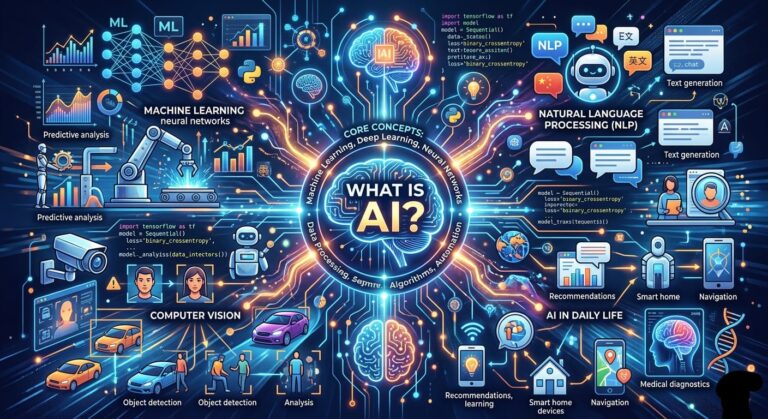
Artificial Intelligence is a branch of computer science focused on creating machines capable of simulating human intelligence. AI systems analyze data, recognize patterns, learn from experiences, and make decisions with minimal human intervention.
The goal of AI is not only to automate tasks but also to enable machines to adapt, improve, and solve complex problems efficiently.
Examples of AI include:
- Voice assistants
- Chatbots
- Facial recognition systems
- Recommendation algorithms
- Autonomous vehicles
- Medical diagnosis tools
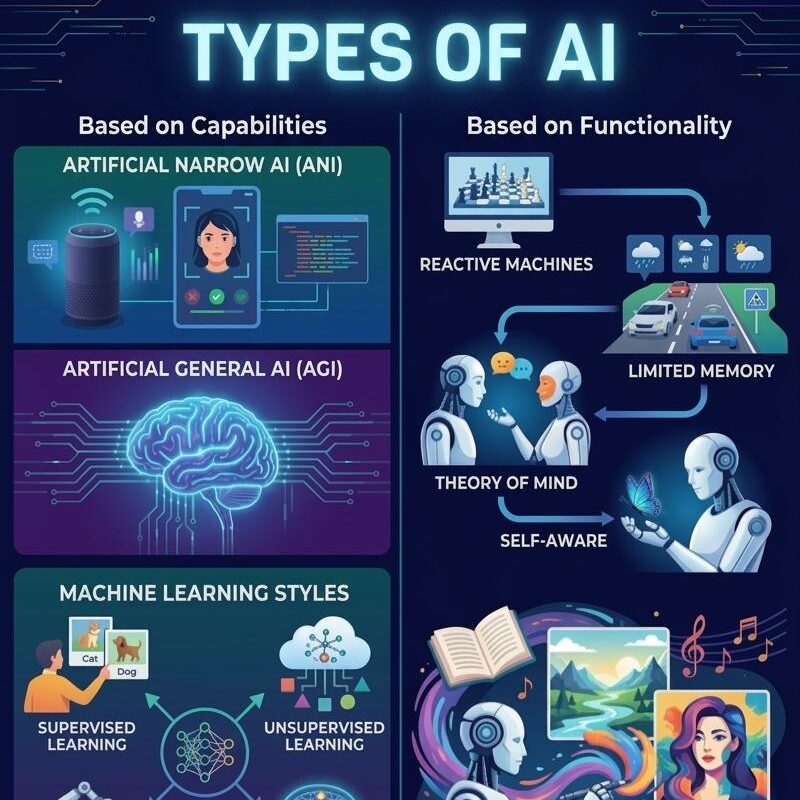
AI can be classified in two major ways:
- Based on Capabilities
- Based on Functionality
Let’s examine both classifications in detail.
Types of AI Based on Capabilities
Capability-based classification focuses on the intelligence level of AI systems.
1. Narrow AI (Weak AI)
Narrow AI is the most common form of AI available today. It is designed to perform specific tasks and operates within a limited range of functions.
Unlike humans, Narrow AI cannot perform tasks outside its programmed domain.
Examples of Narrow AI
- Voice assistants
- Recommendation engines
- Spam filters
- Image recognition software
- Language translation tools
Characteristics
- Task-specific
- Fast and efficient
- Data-driven learning
- Cannot generalize beyond training
Advantages
- High accuracy for specialized tasks
- Cost-effective implementation
- Widely available
Limitations
- No self-awareness
- Cannot perform unrelated tasks
- Requires human oversight
Most AI systems currently used worldwide fall under this category.
2. General AI (Strong AI)
General AI refers to machines that possess human-like intelligence and can perform any intellectual task a human can do.
Unlike Narrow AI, General AI would be capable of:
- Learning independently
- Solving unfamiliar problems
- Understanding context
- Adapting to new situations
Potential Capabilities
A General AI system could:
- Write articles
- Drive vehicles
- Diagnose diseases
- Conduct scientific research
- Learn new skills without retraining
Current Status
General AI remains theoretical. Scientists and researchers continue working toward this goal, but no true General AI currently exists.
Challenges
- Human-level reasoning
- Emotional understanding
- Ethical concerns
- Massive computing requirements
General AI is considered one of the most ambitious objectives in AI research.
3. Super AI (Artificial Superintelligence)
Artificial Superintelligence represents a hypothetical future stage where AI surpasses human intelligence in every field.
This includes:
- Creativity
- Problem-solving
- Scientific innovation
- Strategic planning
- Emotional intelligence
Possible Capabilities
A Super AI could potentially:
- Discover cures for diseases
- Solve global challenges
- Design advanced technologies
- Make complex decisions faster than humans
Potential Benefits
- Accelerated innovation
- Improved healthcare
- Economic growth
- Enhanced productivity
Risks
- Loss of human control
- Ethical concerns
- Security threats
- Social disruption
Currently, Super AI exists only in theory and science fiction discussions.
Types of AI Based on Functionality
Another popular classification focuses on how AI systems function.
1. Reactive Machines
Reactive Machines are the simplest form of AI.
These systems:
- Respond to current inputs
- Do not store memories
- Cannot learn from previous experiences
How They Work
Reactive AI analyzes the current situation and chooses the best action based on predefined rules.
Example
A chess-playing computer that evaluates board positions and makes moves without remembering previous games.
Advantages
- Reliable performance
- Fast decision-making
- Easy implementation
Limitations
- No learning capability
- Limited adaptability
- No memory
Reactive Machines represent the foundation of AI development.
2. Limited Memory AI
Limited Memory AI can learn from historical data and past experiences.
Most modern AI applications belong to this category.
How It Works
The system stores temporary information and uses it to improve future decisions.
Examples
- Self-driving cars
- Fraud detection systems
- Recommendation algorithms
- Predictive analytics tools
Advantages
- Improved decision-making
- Learning capability
- Better accuracy
Limitations
- Memory is limited
- Requires large datasets
- Data quality affects performance
This type of AI powers many technologies used daily.
3. Theory of Mind AI
Theory of Mind AI is an advanced concept that involves understanding human emotions, beliefs, intentions, and social interactions.
Such systems would be capable of:
- Recognizing emotions
- Understanding motivations
- Predicting behavior
- Responding socially
Potential Applications
- Advanced healthcare assistants
- Emotional support robots
- Personalized education systems
- Human-like virtual assistants
Current Status
Researchers are actively exploring this area, but fully functional Theory of Mind AI does not yet exist.
Challenges
- Complex human psychology
- Emotional intelligence modeling
- Ethical considerations
This represents a major step toward human-like AI.
4. Self-Aware AI
Self-Aware AI is the most advanced theoretical form of AI.
Such systems would possess:
- Consciousness
- Self-awareness
- Independent thinking
- Personal understanding of existence
Characteristics
A self-aware AI would:
- Understand its own state
- Have emotions or simulated emotions
- Make autonomous decisions
- Recognize itself as an entity
Current Reality
No self-aware AI exists today.
Ethical Questions
- Rights of intelligent machines
- Human-AI relationships
- Control and responsibility
- Legal implications
Self-aware AI remains a topic of philosophical and scientific debate.
Machine Learning and AI Types
Many people confuse AI with Machine Learning (ML).
Machine Learning is actually a subset of AI.
Types of Machine Learning
Supervised Learning
Uses labeled data to train algorithms.
Examples:
- Email spam detection
- Medical diagnosis
Unsupervised Learning
Finds hidden patterns in unlabeled data.
Examples:
- Customer segmentation
- Data clustering
Reinforcement Learning
Learns through rewards and penalties.
Examples:
- Robotics
- Game-playing AI
These approaches help AI systems improve performance over time.
Real-World Applications of Different AI Types
AI is transforming numerous industries.
Healthcare
Applications include:
- Disease diagnosis
- Medical imaging
- Drug discovery
- Virtual health assistants
Finance
AI helps with:
- Fraud detection
- Risk assessment
- Algorithmic trading
- Customer support
Education
Benefits include:
- Personalized learning
- Automated grading
- Intelligent tutoring systems
Transportation
Examples include:
- Self-driving vehicles
- Traffic prediction
- Route optimization
Retail
AI powers:
- Product recommendations
- Inventory management
- Customer service chatbots
These applications continue expanding every year.
Advantages of Artificial Intelligence
AI offers many benefits:
- Increased Efficiency
- Machines can perform tasks faster than humans.
- Reduced Human Error
- AI systems can improve accuracy in repetitive tasks.
- Automation
- Routine processes can be automated.
- Better Decision-Making
- AI analyzes vast amounts of data quickly.
- 24/7 Availability
- AI systems can operate continuously.
- Innovation
- AI drives breakthroughs across industries.
Challenges and Limitations of AI
Despite its advantages, AI faces several challenges.
- Data Dependency
- AI requires large amounts of quality data.
- Bias and Fairness
- Poor training data can lead to biased outcomes.
- Privacy Concerns
- AI systems often process sensitive information.
- High Development Costs
- Building advanced AI can be expensive.
- Job Displacement
- Automation may affect certain occupations.
- Ethical Issues
- Questions remain regarding accountability and transparency.
- Addressing these challenges is essential for responsible AI development.
Future of AI
The future of AI appears highly promising.
Experts predict advancements in:
- Natural language processing
- Robotics
- Healthcare diagnostics
- Autonomous transportation
- Personalized education
- Scientific research
As computing power increases and algorithms improve, AI capabilities will continue expanding.
While General AI and Super AI remain theoretical, Narrow AI is already transforming society and creating new opportunities worldwide.
Frequently Asked Questions (FAQs)
1. What are the main types of AI?
The main types of AI are Narrow AI, General AI, and Super AI. AI can also be categorized as Reactive Machines, Limited Memory, Theory of Mind, and Self-Aware AI.
2. Which type of AI is used today?
Most current AI systems are Narrow AI and Limited Memory AI, designed for specific tasks.
3. What is Narrow AI?
Narrow AI is specialized AI that performs a particular task, such as voice recognition or recommendation systems.
4. Does General AI exist?
No. General AI remains theoretical and has not yet been achieved.
5. What is Super AI?
Super AI refers to a future AI that surpasses human intelligence in all areas.
6. What is Limited Memory AI?
Limited Memory AI uses historical data and previous experiences to improve decision-making.
7. What is Theory of Mind AI?
Theory of Mind AI aims to understand human emotions, beliefs, and intentions.
8. Is self-aware AI real?
No. Self-aware AI is currently hypothetical and does not exist.
9. How does machine learning relate to AI?
Machine learning is a subset of AI that enables systems to learn from data and improve performance.
10. What industries benefit most from AI?
Healthcare, finance, education, transportation, retail, manufacturing, and customer service all benefit significantly from AI technologies.
Conclusion
Artificial Intelligence encompasses a wide range of technologies designed to simulate human intelligence. Based on capabilities, AI can be categorized as Narrow AI, General AI, and Super AI. Based on functionality, AI includes Reactive Machines, Limited Memory AI, Theory of Mind AI, and Self-Aware AI.
Currently, Narrow AI and Limited Memory AI dominate real-world applications, powering everything from virtual assistants to self-driving cars. Future advancements may eventually lead to more sophisticated forms of intelligence, though significant scientific and ethical challenges remain.
Understanding the different types of AI helps individuals, businesses, and policymakers make informed decisions about the rapidly evolving world of artificial intelligence.