History of AI
Artificial Intelligence (AI) is one of the most groundbreaking technologies in human history. Today, AI powers virtual assistants, recommendation systems, self-driving cars, medical diagnostics, and advanced chatbots.
Explore the history of AI from ancient concepts to modern breakthroughs. Learn how Artificial Intelligence evolved, key milestones, AI winters, and future trends.
However, the journey of AI did not begin in the 21st century. Its roots stretch back thousands of years through myths, philosophical ideas, mathematical discoveries, and technological innovations.
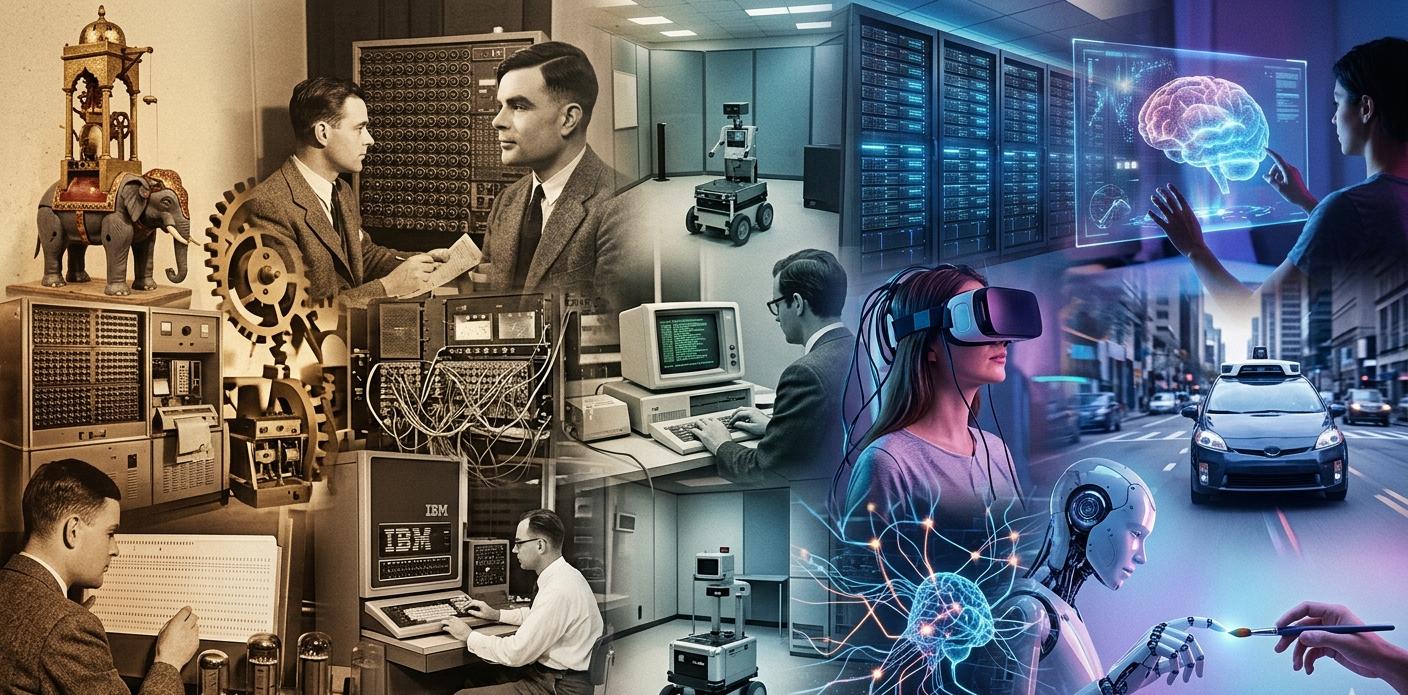
The history of AI is a fascinating story of human ambition to create intelligent machines capable of thinking, learning, and solving problems. Over the decades, AI has experienced periods of rapid progress, disappointment, and resurgence.
What was once considered science fiction has become a reality that influences nearly every aspect of modern life.
In this article, we’ll explore the complete history of AI, from ancient concepts to modern breakthroughs and future possibilities.
What Is Artificial Intelligence?
Before diving into the history, it’s important to understand what AI means.
Artificial Intelligence refers to the ability of machines and computer systems to perform tasks that normally require human intelligence. These tasks include:
- Learning from experience
- Understanding language
- Solving problems
- Recognizing patterns
- Making decisions
- Creating content
AI enables computers to mimic certain aspects of human thinking and behavior.
Early Ideas of Artificial Intelligence
Ancient Myths and Legends
The concept of artificial beings is not new. Ancient civilizations often imagined intelligent machines and mechanical servants.
Greek mythology included stories about mechanical creatures created by gods. One famous example is Talos, a giant bronze automaton said to protect the island of Crete.
Similarly, ancient Chinese and Egyptian civilizations described mechanical devices that appeared to move and act on their own.
Although these stories were fictional, they reflected humanity’s long-standing fascination with creating artificial life.
Philosophical Foundations
Philosophers have debated the nature of intelligence and reasoning for centuries.
Ancient thinkers such as Aristotle developed systems of logic that later influenced computer science and AI.
Aristotle’s methods of reasoning helped establish the idea that human thinking could be represented through rules and logical processes.
Mechanical Machines and Early Automation
The Rise of Automata
During the Middle Ages and Renaissance, inventors created mechanical automata—machines capable of performing simple actions.
These devices included:
- Mechanical clocks
- Automated musical instruments
- Moving statues
- Mechanical birds
While not intelligent, they demonstrated the possibility of machines imitating human or animal behavior.
Blaise Pascal and Mechanical Calculation
In the 17th century, mathematician Blaise Pascal invented one of the first mechanical calculators.
His machine could perform arithmetic operations automatically, reducing the need for manual calculations.
This marked an important step toward automated problem-solving.
Gottfried Wilhelm Leibniz
Leibniz improved on early calculating machines and proposed the idea that reasoning could be reduced to mathematical operations.
His vision of symbolic reasoning would later influence AI research.
The Birth of Modern Computing
Charles Babbage
In the 19th century, Charles Babbage designed the Analytical Engine, often considered the first concept of a programmable computer.
Although never fully built during his lifetime, the machine contained many elements found in modern computers:
- Memory
- Processing units
- Input systems
- Output systems
Babbage’s ideas laid the foundation for future computing technology.
Ada Lovelace
Ada Lovelace worked with Babbage and is often regarded as the world’s first computer programmer.
She recognized that machines could potentially do more than calculations.
Lovelace envisioned computers creating music and solving complex problems, ideas that anticipated modern AI applications.
The Foundation of Artificial Intelligence
Alan Turing’s Contributions
The modern history of AI truly began with Alan Turing.
During the 1930s and 1940s, Turing developed theories about computation that became fundamental to computer science.
His concept of the “Turing Machine” demonstrated how machines could process information through logical operations.
The Turing Test
In 1950, Turing published the influential paper “Computing Machinery and Intelligence.”
He proposed a question:
“Can machines think?”
To explore this idea, he introduced the Turing Test.
The test evaluates whether a machine can engage in conversation so effectively that a human cannot distinguish it from another person.
The Turing Test remains one of the most famous concepts in AI history.
The Official Birth of AI (1956)
Dartmouth Conference
The term “Artificial Intelligence” was officially coined in 1956.
A group of researchers gathered at Dartmouth College in the United States for a summer workshop.
Key participants included:
- John McCarthy
- Marvin Minsky
- Claude Shannon
- Nathaniel Rochester
The researchers believed that machines could eventually simulate every aspect of human intelligence.
This conference is widely considered the birth of AI as a formal academic field.
The Golden Age of AI (1956–1974)
Following the Dartmouth Conference, AI research experienced rapid growth.
Scientists developed programs capable of solving mathematical problems and performing logical reasoning.
Early Successes
Important AI systems included:
Logic Theorist
Created in 1956, Logic Theorist could prove mathematical theorems.
Many researchers viewed it as the first genuine AI program.
ELIZA
Developed in the 1960s, ELIZA simulated human conversation.
Although simple by today’s standards, many users believed they were talking to a real person.
SHRDLU
SHRDLU demonstrated natural language understanding within a limited virtual environment.
It could interpret commands and answer questions about objects.
Growing Optimism
Researchers predicted that human-level AI could be achieved within a few decades.
Funding increased significantly as governments and universities invested heavily in AI research.
The First AI Winter (1974–1980)
Despite early optimism, AI progress slowed dramatically.
Researchers discovered that many problems were far more difficult than expected.
Challenges
Computers lacked:
- Sufficient processing power
- Large datasets
- Advanced algorithms
Many AI systems worked only in limited environments and struggled with real-world complexity.
Reduced Funding
As expectations went unmet, funding agencies reduced support.
This period became known as the First AI Winter.
The Rise of Expert Systems (1980s)
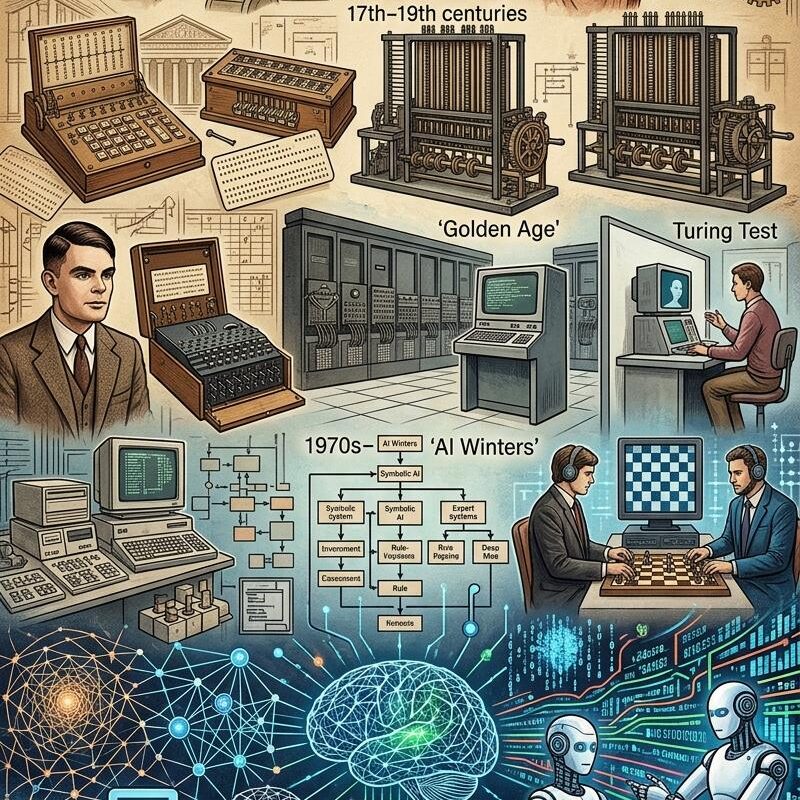
AI experienced renewed interest during the 1980s through expert systems.
What Are Expert Systems?
Expert systems use rules and knowledge bases to mimic human experts.
They can provide recommendations and solve specialized problems.
Examples included:
- Medical diagnosis systems
- Financial planning tools
- Engineering support systems
Commercial Success
Businesses adopted expert systems to improve efficiency and decision-making.
AI once again attracted investment and media attention.
The Second AI Winter (Late 1980s–1990s)
Expert systems eventually revealed limitations.
They required extensive manual rule creation and struggled to adapt to new situations.
Declining Interest
Maintenance costs increased while performance remained limited.
As a result:
- Funding decreased
- Commercial interest faded
- AI entered another slowdown
This period became known as the Second AI Winter.
Machine Learning Revolution
The revival of AI came through machine learning.
What Changed?
Instead of programming every rule manually, researchers taught computers to learn from data.
Machine learning enabled systems to improve automatically through experience.
Key Advantages
Machine learning offered:
- Better adaptability
- Improved accuracy
- Scalability
- Reduced manual programming
This shift transformed AI development.
Deep Learning Breakthroughs
Neural Networks
Researchers revisited neural networks inspired by the human brain.
Advances in computing power made large neural networks practical.
Big Data
The growth of the internet generated enormous datasets that could train AI systems.
Graphics Processing Units (GPUs)
GPUs accelerated AI training significantly.
Together, these developments fueled the deep learning revolution.
AI Achievements in the 21st Century
IBM Deep Blue
In 1997, IBM’s Deep Blue defeated world chess champion Garry Kasparov.
This historic event demonstrated AI’s ability to outperform humans in complex games.
IBM Watson
In 2011, Watson defeated top champions on the quiz show Jeopardy!
The achievement showcased advances in natural language processing.
Self-Driving Cars
Companies began developing autonomous vehicles capable of navigating roads with minimal human intervention.
Image Recognition
AI systems achieved remarkable accuracy in recognizing objects, faces, and scenes.
The Generative AI Era
The 2020s marked the rise of Generative AI.
What Is Generative AI?
Generative AI creates new content rather than simply analyzing existing data.
Examples include:
- Text generation
- Image creation
- Video production
- Music composition
- Code generation
Why Generative AI Matters
These systems can:
- Assist creativity
- Increase productivity
- Automate content creation
- Enhance communication
Generative AI quickly became one of the fastest-growing technology sectors.
AI in 2026
Today, AI influences nearly every industry.
- Healthcare
- AI assists doctors with diagnosis and treatment planning.
- Education
- Students use AI-powered tutoring and learning tools.
- Business
- Companies automate tasks and improve customer service using AI.
- Entertainment
- AI generates art, music, videos, and interactive experiences.
- Research
- Scientists use AI to accelerate discoveries across multiple disciplines.
- AI has become an essential technology rather than an experimental concept.
Challenges Facing AI
Despite remarkable progress, several challenges remain.
Ethical Concerns
- Questions arise regarding fairness, accountability, and transparency.
Privacy Issues
- AI often relies on large amounts of personal data.
Job Displacement
- Automation may replace some jobs while creating new opportunities.
Misinformation
- Generative AI can produce misleading content if used irresponsibly.
- Addressing these concerns is critical for AI’s future development.
The Future of AI
Experts predict continued AI advancement.
Future developments may include:
- Smarter virtual assistants
- Advanced robotics
- Better healthcare diagnostics
- More powerful language models
- Autonomous transportation
- Scientific breakthroughs
While human-level AI remains uncertain, AI capabilities will likely continue expanding rapidly.
Frequently Asked Questions (FAQs)
1. When was Artificial Intelligence invented?
AI became an official academic field in 1956 during the Dartmouth Conference.
2. Who is known as the father of AI?
John McCarthy is often called the father of Artificial Intelligence because he coined the term AI.
3. What was the first AI program?
Logic Theorist, developed in 1956, is widely considered the first AI program.
4. What is the Turing Test?
The Turing Test evaluates whether a machine can imitate human conversation convincingly.
5. What caused the AI winters?
AI winters occurred due to unmet expectations, limited computing power, and reduced funding.
6. What revived AI after the AI winters?
Machine learning, big data, and improved computing power helped revive AI research.
7. What is deep learning?
Deep learning is a branch of machine learning that uses neural networks to process data.
8. What was Deep Blue?
Deep Blue was IBM’s chess-playing computer that defeated world champion Garry Kasparov in 1997.
9. What is Generative AI?
Generative AI creates new content such as text, images, videos, music, and code.
10. What is the future of AI?
The future of AI includes smarter automation, advanced robotics, improved healthcare, and more personalized digital experiences.
Conclusion
The history of AI is a story of innovation, ambition, setbacks, and remarkable achievements. From ancient myths and mechanical automata to modern generative AI systems, humanity has pursued the dream of creating intelligent machines for centuries.
The official birth of AI in 1956 launched a field that has transformed technology and society. Despite periods of disappointment known as AI winters, advances in machine learning, deep learning, and computing power have enabled extraordinary progress.
Today, AI is reshaping industries worldwide, and its influence continues to grow. Understanding the history of AI helps us appreciate both its achievements and the challenges that lie ahead as we move into an increasingly intelligent future.