Future of AI
Artificial Intelligence (AI) has evolved from a futuristic concept into one of the most powerful technologies shaping modern society. From virtual assistants and recommendation systems to self-driving vehicles and advanced healthcare solutions, AI is transforming industries and changing how people live and work.
As technology continues to advance, the future of AI promises even greater innovation, efficiency, and opportunities.
Experts predict that AI will become deeply integrated into every aspect of life over the next decade. Businesses, governments, educational institutions, and individuals are increasingly investing in AI-driven solutions to improve productivity, decision-making, and customer experiences.
This article explores the future of artificial intelligence, its potential impact on various industries, emerging trends, challenges, and what society can expect as AI continues to evolve.
What Is Artificial Intelligence?
Artificial Intelligence refers to computer systems designed to perform tasks that typically require human intelligence. These tasks include:
- Learning from data
- Understanding language
- Recognizing images and patterns
- Solving problems
- Making decisions
- Predicting outcomes
AI technologies include machine learning, deep learning, natural language processing (NLP), computer vision, robotics, and generative AI.
The rapid development of these technologies is paving the way for more intelligent systems capable of handling increasingly complex tasks.
The Current State of AI
Today, AI is already a significant part of everyday life. Popular applications include:
- Chatbots and virtual assistants
- Search engine algorithms
- Online shopping recommendations
- Fraud detection systems
- Medical diagnostic tools
- Autonomous vehicles
- Smart home devices
Companies across various industries use AI to automate repetitive tasks, analyze large datasets, and improve customer service.
Generative AI tools such as ChatGPT, image generators, and AI-powered coding assistants have demonstrated how AI can enhance creativity and productivity.
Key Trends Shaping the Future of AI
1. Generative AI Expansion
Generative AI is expected to become even more sophisticated. Future AI systems will create highly realistic:
- Text content
- Images
- Videos
- Music
- Software code
Businesses will increasingly use generative AI for content creation, marketing, software development, and customer engagement.
2. AI-Powered Automation
Automation will continue transforming industries by handling repetitive and time-consuming tasks.
Examples include:
- Manufacturing automation
- Automated customer support
- Financial reporting
- Supply chain management
- Data analysis
This will allow employees to focus on strategic and creative work rather than routine operations.
3. AI in Healthcare
Healthcare is one of the sectors expected to benefit most from AI advancements.
Future AI applications may include:
- Early disease detection
- Personalized treatments
- Drug discovery
- Remote patient monitoring
- Surgical assistance
AI-powered systems could significantly improve healthcare outcomes while reducing costs and increasing accessibility.
4. Autonomous Transportation
Self-driving vehicles continue to improve through AI-powered navigation systems.
Future transportation innovations may include:
- Fully autonomous cars
- AI-controlled public transportation
- Smart traffic management systems
- Autonomous delivery services
These technologies could reduce traffic accidents, improve efficiency, and lower transportation costs.
5. Human-AI Collaboration
Rather than replacing humans entirely, future AI systems will increasingly work alongside people.
Professionals may use AI assistants for:
- Research
- Writing
- Design
- Programming
- Business analysis
Human creativity combined with AI capabilities can create powerful partnerships that boost productivity.
AI in Education
Education is undergoing a major transformation through AI technologies.
Future AI-powered educational tools may offer:
- Personalized Learning
- AI can analyze student performance and create customized learning experiences based on individual needs.
- Intelligent Tutoring Systems
- Students may receive instant feedback and guidance through AI tutors available 24/7.
- Administrative Automation
- Schools and universities can automate scheduling, grading, and administrative tasks.
- Enhanced Accessibility
- AI can provide real-time translations, speech recognition, and learning support for students with disabilities.
- These innovations can make education more accessible, efficient, and effective.
AI and the Future Workforce
One of the most debated topics surrounding AI is its impact on jobs.
Jobs Likely to Be Automated
AI may automate tasks in areas such as:
- Data entry
- Basic accounting
- Customer support
- Manufacturing
- Transportation
New Job Opportunities
At the same time, AI will create new careers, including:
- AI engineers
- Machine learning specialists
- Data scientists
- AI ethicists
- Robotics technicians
- Prompt engineers
Importance of Reskilling
Workers will need to adapt by learning new skills that complement AI technologies.
Critical future skills include:
- Problem-solving
- Creativity
- Leadership
- Communication
- Data literacy
- Technology management
Organizations that invest in workforce training will be better prepared for the AI-driven economy.
AI in Business and Commerce
Businesses are expected to become increasingly dependent on AI.
- Enhanced Customer Experiences
- AI can provide personalized recommendations and support based on customer preferences.
- Predictive Analytics
- Companies can use AI to forecast trends, customer behavior, and market changes.
- Improved Decision-Making
- AI systems can analyze large datasets and provide valuable business insights.
- Cost Reduction
- Automation reduces operational expenses and increases efficiency.
- Businesses that successfully integrate AI may gain significant competitive advantages.

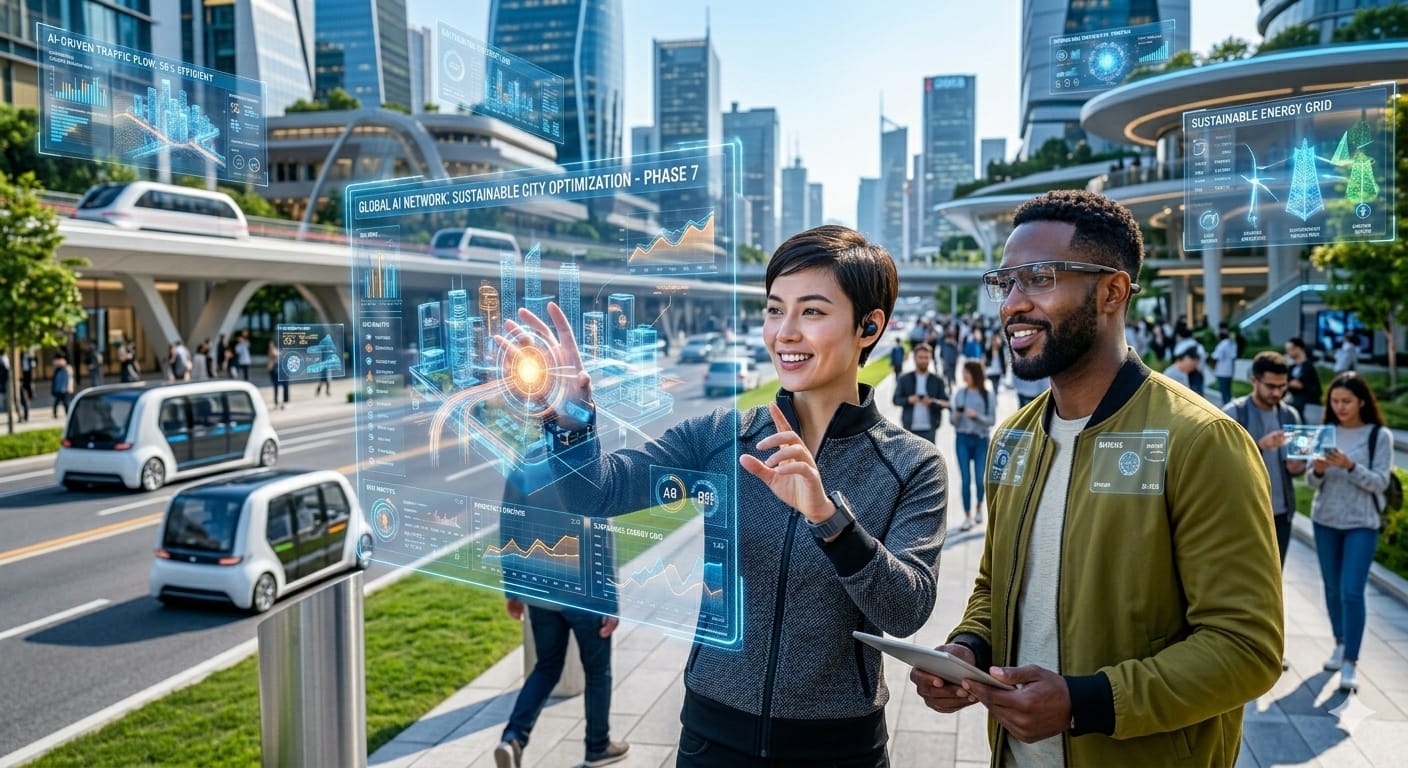
AI in Smart Cities
Future cities will likely rely heavily on AI technologies.
Smart city applications may include:
- Traffic optimization
- Energy management
- Waste management
- Public safety monitoring
- Infrastructure maintenance
AI can help cities become more sustainable, efficient, and livable.
Artificial General Intelligence (AGI)
Artificial General Intelligence refers to AI systems capable of performing any intellectual task that a human can perform.
Unlike current AI systems, which are designed for specific tasks, AGI would possess broader reasoning and learning capabilities.
While AGI remains theoretical, many researchers believe it could become possible in the future.
Potential AGI benefits include:
- Scientific breakthroughs
- Medical advancements
- Complex problem solving
- Accelerated innovation
However, AGI also raises important ethical and safety concerns.
Ethical Challenges of AI
As AI becomes more powerful, society must address several challenges.
- Privacy Concerns
- AI systems often require large amounts of data, raising concerns about personal privacy.
- Bias and Fairness
- AI algorithms may inherit biases from training data, leading to unfair outcomes.
- Job Displacement
- Automation may disrupt certain industries and occupations.
- Security Risks
- Cybercriminals may use AI for sophisticated attacks and fraud.
- Accountability
- Determining responsibility for AI-driven decisions can be challenging.
- Governments and organizations must establish clear regulations and ethical guidelines.
AI and Cybersecurity
Cybersecurity will become increasingly dependent on AI technologies.
AI can help organizations:
- Detect threats faster
- Identify unusual activity
- Prevent cyberattacks
- Respond to security incidents
At the same time, cybercriminals may use AI to develop more advanced attack methods.
The future of cybersecurity will likely involve an ongoing battle between defensive and offensive AI systems.
The Role of Governments
Governments worldwide are developing policies to regulate AI.
Future regulations may focus on:
- Data privacy
- Transparency
- Ethical AI development
- Consumer protection
- National security
International cooperation may be necessary to establish global AI standards.
AI and Environmental Sustainability
AI can contribute to environmental protection by optimizing resource usage and reducing waste.
Potential applications include:
- Climate modeling
- Renewable energy optimization
- Smart agriculture
- Wildlife monitoring
- Carbon emission reduction
These innovations could help address some of the world’s most pressing environmental challenges.
What Will AI Look Like in 2030?
By 2030, AI is expected to become significantly more advanced and widespread.
Possible developments include:
- Highly capable virtual assistants
- Smarter healthcare systems
- Fully personalized education
- Advanced autonomous transportation
- AI-driven scientific research
- More efficient businesses
- Intelligent smart homes
AI may become as essential to daily life as the internet is today.
Frequently Asked Questions (FAQs)
1. What is the future of artificial intelligence?
The future of AI includes advanced automation, personalized services, smarter healthcare, autonomous transportation, and improved decision-making across industries.
2. Will AI replace human jobs?
AI will automate some jobs but also create new career opportunities. Many future roles will involve collaboration between humans and AI systems.
3. What industries will benefit most from AI?
Healthcare, finance, education, manufacturing, transportation, retail, and cybersecurity are expected to benefit significantly from AI advancements.
4. What is Artificial General Intelligence (AGI)?
AGI is a theoretical form of AI capable of performing any intellectual task that a human can perform.
5. Is AI safe for society?
AI can be highly beneficial when developed responsibly. Proper regulations and ethical guidelines are necessary to minimize risks.
6. How will AI impact education?
AI will enable personalized learning, intelligent tutoring, automated administration, and improved accessibility for students.
7. Can AI help fight climate change?
Yes. AI can optimize energy use, improve climate modeling, support sustainable agriculture, and reduce carbon emissions.
8. What skills will be important in an AI-driven future?
Creativity, critical thinking, communication, leadership, data literacy, and technology-related skills will be increasingly valuable.
9. Will self-driving cars become common?
Many experts believe autonomous vehicles will become more common as AI technology continues to improve.
10. How can businesses prepare for the future of AI?
Businesses should invest in AI tools, employee training, data infrastructure, and ethical AI practices to remain competitive.
Conclusion
The future of artificial intelligence holds extraordinary promise. AI has the potential to revolutionize healthcare, education, transportation, business, and countless other industries. As technology continues to evolve, AI will likely become a fundamental part of everyday life, helping solve complex problems and improving efficiency across society.
However, maximizing AI’s benefits will require careful attention to ethical considerations, privacy concerns, workforce adaptation, and responsible regulation. By balancing innovation with accountability, humanity can harness the full power of AI while minimizing risks.
The coming decade will be one of the most transformative periods in technological history, and artificial intelligence will undoubtedly be at the center of that transformation.



One Comment