What Is AI Agent Architecture? A Complete Guide for 2026
Artificial Intelligence (AI) has evolved rapidly over the last few years. Traditional AI systems could answer questions, generate content, and analyze data, but they often required constant human guidance. Today, AI agents are changing the landscape by acting more independently, making decisions, completing tasks, and interacting with digital environments.
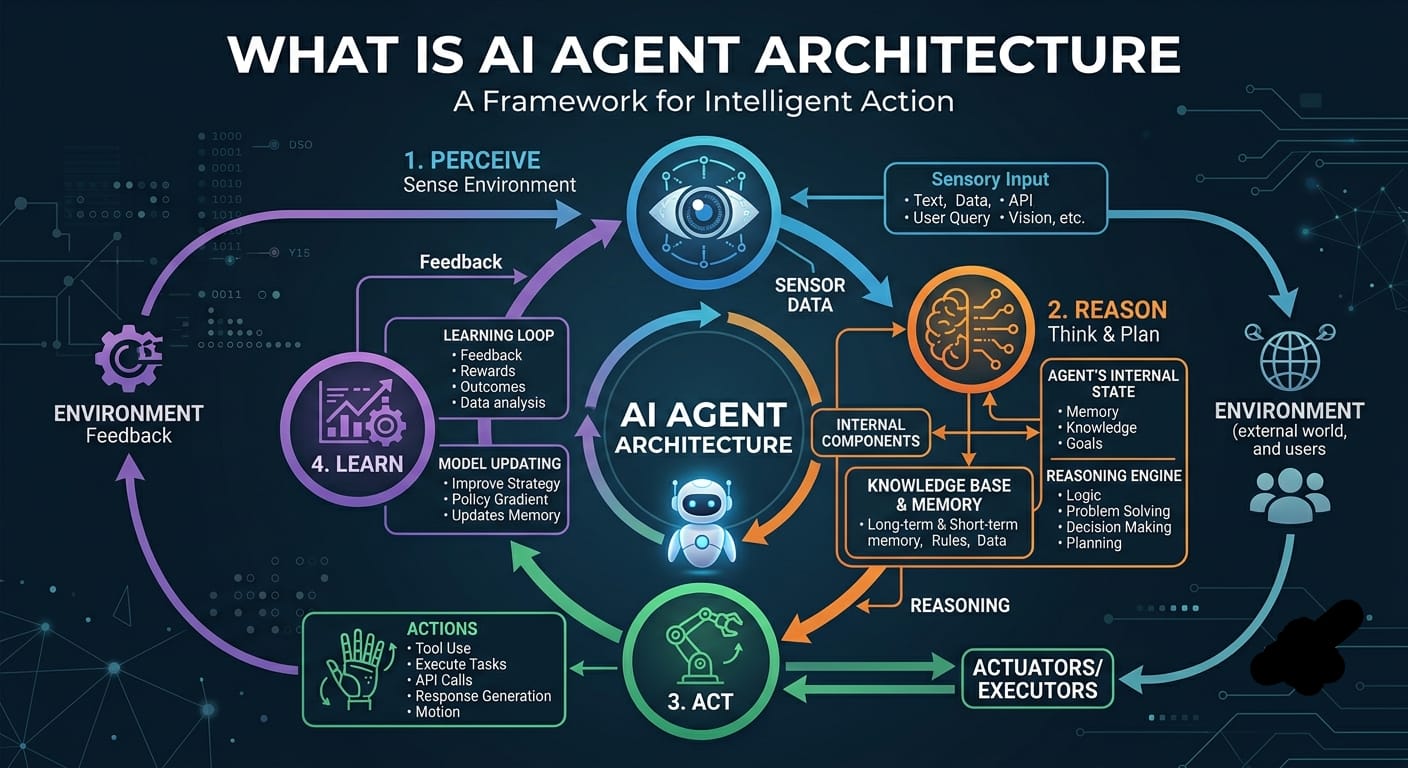
Behind every intelligent AI agent lies a framework known as AI Agent Architecture. This architecture determines how an AI agent perceives information, processes data, makes decisions, remembers past interactions, and performs actions.
As AI agents become increasingly important in business, software development, customer service, healthcare, and automation, understanding AI agent architecture has become essential for developers, entrepreneurs, and technology enthusiasts.
This comprehensive guide explains what AI agent architecture is, how it works, its key components, different types, benefits, challenges, and future trends for 2026 and beyond.
What Is AI Agent Architecture?
AI Agent Architecture refers to the structural design and framework that enables an AI agent to operate intelligently within its environment.
It defines:
- How the agent receives information
- How it processes data
- How it stores memory
- How it makes decisions
- How it executes actions
- How it learns from feedback
In simple terms, AI agent architecture acts as the “brain and nervous system” of an AI agent.
Just as humans use their senses, memory, reasoning, and actions to interact with the world, AI agents rely on architectural components to perform tasks autonomously.
What Is an AI Agent?
Before understanding the architecture, it is important to understand what an AI agent is.
An AI agent is a software system capable of:
- Observing its environment
- Analyzing information
- Making decisions
- Taking actions
- Learning from outcomes
Examples include:
- Virtual assistants
- AI customer support agents
- Autonomous vehicles
- Trading bots
- AI research assistants
- Smart home systems
Unlike traditional software that follows fixed rules, AI agents can adapt and respond intelligently to changing situations.
Why AI Agent Architecture Matters
A well-designed architecture determines how effective an AI agent will be.
Without proper architecture, an AI system may:
- Make poor decisions
- Forget important information
- Fail to complete tasks
- Produce inconsistent results
Good architecture helps agents:
- Operate autonomously
- Improve accuracy
- Learn continuously
- Handle complex workflows
- Scale efficiently
As AI applications become more advanced, architecture becomes increasingly important.
Core Components of AI Agent Architecture
Most AI agent systems contain several essential components.
1. Perception Layer
The perception layer gathers information from the environment.
This information may come from:
- Text inputs
- Voice commands
- Images
- Sensors
- Databases
- APIs
The perception system converts raw information into a format that the AI can understand.
Example
A customer support AI receives:
“Where is my order?”
The perception layer identifies:
- Customer intent
- Order inquiry
- Relevant customer information
2. Memory System
Memory allows AI agents to retain information over time.
There are generally two types:
Short-Term Memory
Stores information needed for current tasks.
Example:
Remembering previous messages during a conversation.
Long-Term Memory
Stores information for future use.
Example:
Remembering customer preferences or historical interactions.
Memory improves personalization and decision-making.
3. Reasoning Engine
The reasoning engine serves as the decision-making center.
It analyzes:
- Goals
- Context
- Available information
- Constraints
The engine determines the best course of action.
Example
An AI travel assistant may compare:
- Prices
- Flight times
- User preferences
Then recommend the best option.
4. Planning Module
Planning enables agents to break complex tasks into smaller steps.
Instead of solving everything at once, the AI creates an action plan.
Example
Task:
“Book a business trip.”
The planning system may:
- Find flights
- Compare hotels
- Check schedule availability
- Reserve transportation
- Confirm bookings
Planning improves efficiency and task completion rates.
5. Action Layer
The action layer executes decisions.
Possible actions include:
- Sending emails
- Updating databases
- Making API calls
- Generating reports
- Scheduling meetings
- Controlling devices
This is where the AI interacts with the external world.
6. Learning Mechanism
Advanced AI agents continuously improve.
Learning systems help agents:
- Analyze outcomes
- Correct mistakes
- Refine strategies
- Improve future decisions
This allows the agent to become more effective over time.
How AI Agent Architecture Works
The workflow typically follows these steps:
Step 1: Receive Input
The agent receives information from users or systems.
Step 2: Process Information
The perception layer analyzes incoming data.
Step 3: Retrieve Memory
Relevant information is recalled.
Step 4: Reason and Plan
The AI evaluates options and creates a strategy.
Step 5: Execute Actions
Tasks are performed.
Step 6: Learn from Results
Feedback improves future performance.
This cycle continuously repeats as the agent interacts with its environment.
Types of AI Agent Architectures
Different applications require different architectural approaches.
1. Reactive Architecture
Reactive agents respond directly to current inputs.
Characteristics:
- No memory
- Fast responses
- Simple design
Example
Basic chatbots.
Advantages
- Fast
- Lightweight
- Easy to implement
Disadvantages
- Limited intelligence
- No learning capability
2. Deliberative Architecture
Deliberative agents think before acting.
They:
- Analyze situations
- Build internal models
- Create plans
Example
AI logistics systems.
Advantages
- Better decision-making
- Strategic planning
Disadvantages
- Slower processing
3. Hybrid Architecture
Hybrid systems combine reactive and deliberative approaches.
They can:
- React quickly
- Plan strategically
This is one of the most popular architectures in 2026.
Example
Advanced AI assistants.
4. Multi-Agent Architecture
Multiple AI agents collaborate to solve problems.
Each agent specializes in a specific task.
Example
A research system may use:
- Research agent
- Writing agent
- Fact-checking agent
- Analysis agent
Together they complete complex projects.
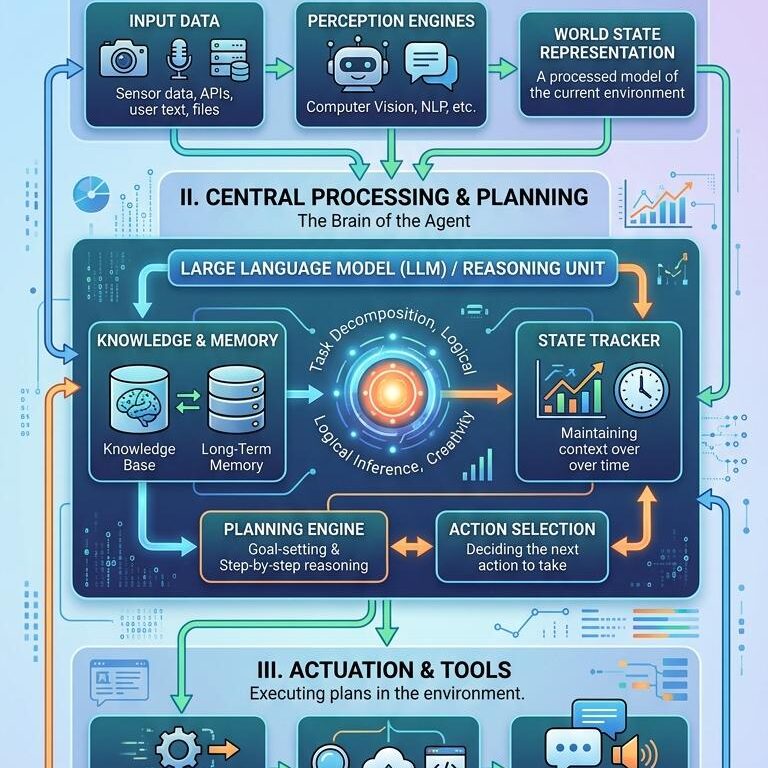
AI Agent Architecture Layers
Modern AI agents often include multiple layers.
Layer 1: Input Layer
Collects information.
Layer 2: Processing Layer
Analyzes incoming data.
Layer 3: Memory Layer
Stores information.
Layer 4: Reasoning Layer
Makes decisions.
Layer 5: Planning Layer
Creates action strategies.
Layer 6: Execution Layer
Performs actions.
Layer 7: Feedback Layer
Measures outcomes and improves performance.
This layered approach improves scalability and maintainability.
Popular AI Agent Architecture Models
Several architecture models dominate AI development.
ReAct Architecture
ReAct stands for:
Reasoning + Acting
The AI alternates between:
- Thinking
- Acting
- Observing results
This method improves problem-solving capabilities.
Tool-Using Agents
These agents use external tools such as:
- Search engines
- Databases
- Calculators
- APIs
This expands their capabilities beyond their training data.
Autonomous Agent Systems
Examples include:
- Task automation agents
- Business workflow agents
- Research agents
These systems operate with minimal human intervention.
Multi-Agent Systems
Teams of AI agents collaborate on large tasks.
Benefits include:
- Better specialization
- Faster execution
- Improved scalability
Real-World Applications of AI Agent Architecture
Customer Service
AI agents answer questions, resolve issues, and provide support.
Healthcare
AI assists with:
- Diagnostics
- Scheduling
- Patient communication
Finance
Applications include:
- Fraud detection
- Trading automation
- Financial analysis
Education
AI tutors personalize learning experiences.
E-commerce
AI agents manage:
- Product recommendations
- Customer support
- Inventory monitoring
Software Development
AI coding assistants help developers write and review code.
Benefits of AI Agent Architecture
- Improved Automation
- Tasks can be completed with little human involvement.
- Better Decision-Making
- Reasoning engines improve accuracy.
- Scalability
- Systems can handle larger workloads.
- Continuous Learning
- Performance improves over time.
- Personalization
- Memory systems create customized experiences.
- Cost Reduction
- Automation lowers operational expenses.
Challenges of AI Agent Architecture
Despite its advantages, AI agent architecture faces challenges.
- Memory Management
- Large memory systems can become expensive.
- Security Risks
- Agents interacting with external systems require strong security controls.
- Hallucinations
- AI may generate incorrect information.
- Complexity
- Advanced architectures can be difficult to build and maintain.
- Ethical Concerns
- Developers must ensure responsible AI behavior.
Future of AI Agent Architecture
The future of AI agents is incredibly promising.
Emerging trends include:
- Autonomous Workflows
- AI agents managing complete business processes.
- Long-Term Memory Systems
- Agents remembering information over extended periods.
- Agent Collaboration
- Multiple AI agents working together efficiently.
- Self-Improving Systems
- Agents continuously optimizing themselves.
- Human-AI Teams
- Humans and AI agents collaborating seamlessly.
- By 2030, AI agents may become central to most digital workflows.
Frequently Asked Questions (FAQs)
1. What is AI agent architecture?
AI agent architecture is the framework that defines how an AI agent perceives information, stores memory, reasons, plans actions, and interacts with its environment.
2. Why is AI agent architecture important?
It determines how effectively an AI agent can make decisions, complete tasks, and adapt to changing situations.
3. What are the main components of AI agent architecture?
The main components include perception, memory, reasoning, planning, action execution, and learning systems.
4. What is the difference between AI architecture and AI agent architecture?
AI architecture refers to the overall design of an AI system, while AI agent architecture focuses specifically on autonomous decision-making agents.
5. What is a multi-agent system?
A multi-agent system consists of multiple AI agents working together to accomplish complex tasks.
6. Can AI agents learn over time?
Yes. Many modern AI agents use feedback and learning mechanisms to improve performance continuously.
7. What is the ReAct framework?
ReAct stands for Reasoning and Acting, allowing AI agents to think through problems before taking actions.
8. Where are AI agents used today?
AI agents are used in customer service, healthcare, finance, education, e-commerce, software development, and many other industries.
9. What challenges do AI agent architectures face?
Common challenges include memory management, security risks, hallucinations, system complexity, and ethical concerns.
10. What is the future of AI agent architecture?
Future AI agents will feature improved memory, better collaboration, greater autonomy, and more advanced decision-making capabilities.
Conclusion
AI agent architecture is the foundation that enables intelligent AI systems to perceive, reason, remember, plan, and act. As AI technology advances, architecture plays a critical role in determining how effectively agents can perform complex tasks and operate autonomously.
From customer service and healthcare to finance and software development, AI agents are transforming industries worldwide. Understanding AI agent architecture helps businesses, developers, and technology leaders build smarter, more capable systems that can adapt to evolving challenges.
As we move further into 2026, AI agent architecture will continue to evolve, driving the next generation of intelligent automation and digital transformation.