The 18 Best AI Platforms in 2026
Artificial Intelligence (AI) has transformed the way people work, learn, create content, write code, analyze data, and run businesses. In 2026, AI platforms are more powerful than ever, offering advanced capabilities such as natural language processing, image generation, video creation, automation, coding assistance, research support, and business intelligence.
Whether you’re a student, blogger, marketer, developer, entrepreneur, or large enterprise, choosing the right AI platform can significantly improve productivity and efficiency. With hundreds of AI tools available today, finding the best option can be overwhelming.
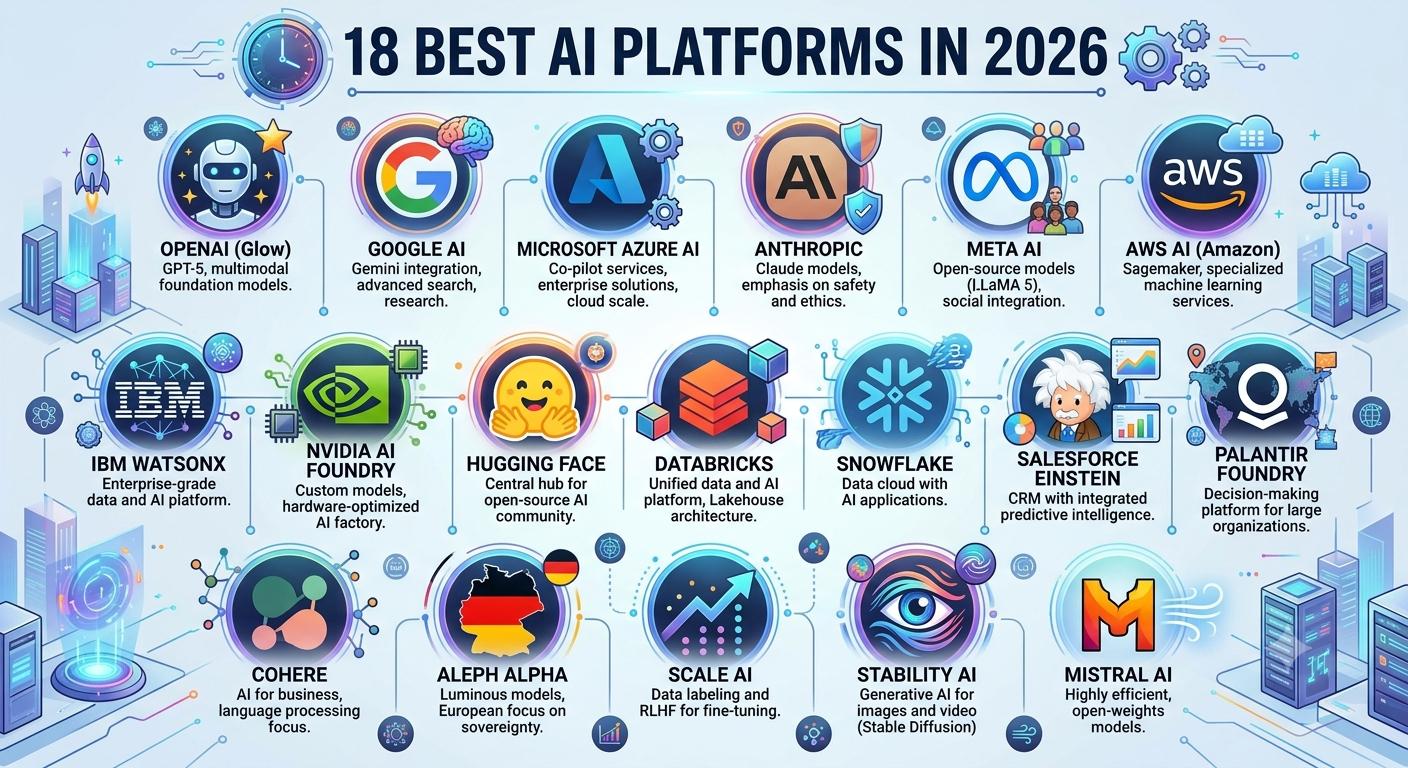
This guide explores the 18 best AI platforms in 2026, highlighting their features, strengths, use cases, and pricing considerations to help you choose the right solution.
What Makes a Great AI Platform?
Before reviewing the top platforms, let’s understand what separates great AI platforms from average ones.
A quality AI platform should offer:
- High accuracy and reliability
- Easy-to-use interface
- Fast response times
- Multiple AI models and capabilities
- Strong security and privacy controls
- API access for developers
- Integration with existing tools
- Regular updates and improvements
- Cost-effective pricing
The best AI platforms combine these features while addressing specific user needs.
1. ChatGPT
Overview
ChatGPT remains one of the most popular AI platforms in 2026. Developed by OpenAI, it has become the go-to solution for writing, coding, brainstorming, research, customer support, and productivity tasks.
Key Features
- Advanced conversational AI
- Content creation
- Coding assistance
- Data analysis
- Image generation
- Voice interaction
- Custom GPTs
- File uploads
Best For
- Bloggers
- Students
- Marketers
- Businesses
- Developers
Pros
- Extremely versatile
- Easy to use
- Strong reasoning abilities
- Frequent updates
Cons
- Premium features require a paid plan
2. Gemini
Overview
Google’s Gemini platform has evolved into one of the strongest competitors in the AI market. It integrates deeply with Google Workspace and Google Search.
Key Features
- Multimodal AI
- Real-time web access
- Workspace integration
- Document analysis
- Coding support
Best For
- Google Workspace users
- Researchers
- Businesses
Pros
- Strong search capabilities
- Excellent document handling
- Large context window
Cons
- Some advanced features require subscriptions
3. Claude
Overview
Claude is known for its long-context understanding and natural writing abilities. It excels in analyzing lengthy documents and generating detailed content.
Key Features
- Massive context windows
- Strong reasoning
- Research assistance
- Content generation
- Coding support
Best For
- Writers
- Researchers
- Professionals
Pros
- Excellent writing quality
- Handles large files
- Strong safety measures
Cons
- Fewer integrations than some competitors
4. Microsoft Copilot
Overview
Microsoft Copilot integrates AI directly into Microsoft products such as Word, Excel, PowerPoint, Outlook, and Teams.
Key Features
- Office integration
- Data analysis
- Presentation creation
- Email drafting
- Workflow automation
Best For
- Businesses
- Corporate teams
- Microsoft users
Pros
- Excellent workplace productivity
- Enterprise-ready security
Cons
- Best experience requires Microsoft ecosystem
5. Perplexity AI
Overview
Perplexity has become a leading AI-powered search and research platform. It provides cited answers and real-time information.
Key Features
- AI search engine
- Source citations
- Research assistance
- Document analysis
- Academic support
Best For
- Students
- Researchers
- Journalists
Pros
- Accurate sourcing
- Fast answers
- Strong research capabilities
Cons
- Less suitable for creative writing
6. Midjourney
Overview
Midjourney remains one of the most impressive AI image-generation platforms available in 2026.
Key Features
- Photorealistic image generation
- Artistic styles
- Concept art creation
- Commercial use support
Best For
- Designers
- Artists
- Marketing agencies
Pros
- Outstanding image quality
- Creative outputs
Cons
- Learning curve for beginners
7. DALL-E
Overview
DALL-E continues to be a major player in AI image creation, allowing users to generate images from text prompts.
Key Features
- Text-to-image generation
- Image editing
- Image expansion
- High-resolution outputs
Best For
- Content creators
- Marketers
- Social media managers
Pros
- Easy to use
- Excellent image editing tools
Cons
- Limited advanced customization
8. Jasper AI
Overview
Jasper AI focuses heavily on marketing and content creation.
Key Features
- Blog writing
- Ad copy generation
- Brand voice training
- SEO content creation
Best For
- Digital marketers
- Agencies
- Businesses
Pros
- Marketing-focused tools
- Team collaboration
Cons
- Expensive for individual users
9. Copy.ai
Overview
Copy.ai helps businesses automate content creation and workflows.
Key Features
- Marketing automation
- Content generation
- Sales outreach
- Workflow building
Best For
- Sales teams
- Marketing departments
Pros
- Time-saving automation
- User-friendly interface
Cons
- Limited advanced customization
10. Notion AI
Overview
Notion AI enhances productivity by bringing AI directly into the popular workspace platform.
Key Features
- AI writing assistance
- Meeting summaries
- Task management
- Knowledge organization
Best For
- Teams
- Students
- Startups
Pros
- Seamless workspace integration
- Productivity-focused
Cons
- Best within Notion ecosystem
11. Synthesia
Overview
Synthesia leads the AI video creation market with realistic AI avatars and professional video production tools.
Key Features
- AI presenters
- Video generation
- Multilingual support
- Training videos
Best For
- Businesses
- Educators
- Marketers
Pros
- Professional results
- No camera needed
Cons
- Limited creative freedom
12. Runway
Overview
Runway has become one of the top AI video-generation platforms.
Key Features
- Text-to-video
- Video editing
- Motion tracking
- AI effects
Best For
- Filmmakers
- Content creators
- Advertisers
Pros
- Powerful video tools
- High-quality outputs
Cons
- Resource-intensive projects
13. ElevenLabs
Overview
ElevenLabs dominates AI voice generation with realistic text-to-speech capabilities.
Key Features
- Voice cloning
- Text-to-speech
- Multilingual voices
- Audio production
Best For
- Podcasters
- YouTubers
- Businesses
Pros
- Natural voices
- High-quality audio
Cons
- Premium plans can be costly
14. Grammarly AI
Overview
Grammarly has expanded beyond grammar correction into a complete AI writing assistant.
Key Features
- Writing enhancement
- Tone detection
- Content suggestions
- Grammar correction
Best For
- Professionals
- Students
- Writers
Pros
- Improves writing quality
- Easy integration
Cons
- Limited creative generation
15. Canva AI
Overview
Canva AI combines design tools with AI-powered content creation.
Key Features
- AI design generation
- Presentation creation
- Image editing
- Marketing content
Best For
- Small businesses
- Designers
- Social media creators
Pros
- Beginner-friendly
- Large template library
Cons
- Advanced users may need more control
16. Hugging Face
Overview
Hugging Face remains the leading platform for open-source AI models and machine learning communities.
Key Features
- Model hosting
- AI datasets
- APIs
- Open-source collaboration
Best For
- Developers
- Researchers
- AI engineers
Pros
- Huge model library
- Strong community support
Cons
- Technical knowledge required
17. DataRobot
Overview
DataRobot simplifies machine learning deployment for businesses.
Key Features
- Automated machine learning
- Predictive analytics
- AI deployment
- Monitoring tools
Best For
- Enterprises
- Data scientists
Pros
- Enterprise-grade tools
- Strong automation
Cons
- High pricing
18. IBM Watsonx
Overview
IBM Watsonx is a comprehensive enterprise AI platform designed for large-scale business operations.
Key Features
- AI governance
- Machine learning
- Data management
- Enterprise security
Best For
- Large organizations
- Regulated industries
Pros
- Strong compliance features
- Enterprise-ready
Cons
- Complex setup process
How to Choose the Right AI Platform
When selecting an AI platform, consider:
Your Goals
- Writing content
- Creating images
- Video production
- Research
- Coding
- Business automation
Budget
- Free tools are suitable for beginners, while businesses may benefit from premium subscriptions.
Ease of Use
- Choose platforms that match your technical skill level.
Integration Requirements
- Ensure the platform works with your existing software stack.
Scalability
- Businesses should select solutions that can grow with future needs.
Future of AI Platforms
The AI industry continues to evolve rapidly. In the coming years, users can expect:
- More personalized AI assistants
- Better reasoning capabilities
- Improved video generation
- Real-time collaboration features
- Enhanced security and privacy
- Industry-specific AI solutions
- Lower costs and wider accessibility
AI platforms will increasingly become essential tools for professionals, businesses, and individuals worldwide.
FAQs
1. What is the best AI platform in 2026?
ChatGPT is widely considered one of the best overall AI platforms due to its versatility, reasoning abilities, and broad range of applications.
2. Which AI platform is best for content writing?
Jasper AI, ChatGPT, Claude, and Grammarly AI are among the top choices for content creation.
3. Which AI tool is best for image generation?
Midjourney and DALL-E are currently leading AI image-generation platforms.
4. What is the best AI platform for video creation?
Runway and Synthesia are among the most popular AI video-generation tools.
5. Which AI platform is best for students?
ChatGPT, Gemini, Perplexity AI, and Notion AI are excellent options for students.
6. Which AI platform helps with coding?
ChatGPT, Claude, Gemini, and GitHub Copilot are highly effective coding assistants.
7. Are AI platforms free to use?
Many platforms offer free plans, but advanced features typically require paid subscriptions.
8. Which AI platform is best for businesses?
Microsoft Copilot, IBM Watsonx, DataRobot, and ChatGPT are strong choices for business use.
9. Is AI replacing human workers?
AI is automating certain tasks, but it is primarily augmenting human productivity rather than completely replacing workers.
10. What should I consider before choosing an AI platform?
Evaluate your goals, budget, integrations, ease of use, scalability, and required features before selecting a platform.
Conclusion
The best AI platform in 2026 depends on your goals and workflow. ChatGPT remains one of the most versatile options for general use, while Gemini and Claude excel in research and productivity. Midjourney and DALL-E dominate image generation, Runway leads AI video creation, and ElevenLabs offers industry-leading voice synthesis.
Businesses may benefit from Microsoft Copilot, DataRobot, or IBM Watsonx, while creators often prefer Canva AI, Jasper AI, and Synthesia. Developers and researchers can leverage Hugging Face for advanced AI development.
By understanding each platform’s strengths and weaknesses, you can choose the AI solution that best fits your needs and stay ahead in the rapidly evolving world of artificial intelligence.