Artificial Intelligence (AI) has transformed the way people work, communicate, learn, and manage daily tasks. One of the most popular applications of AI today is the AI assistant.
From answering questions and scheduling meetings to generating content and analyzing data, AI assistants have become valuable tools for individuals and businesses alike.
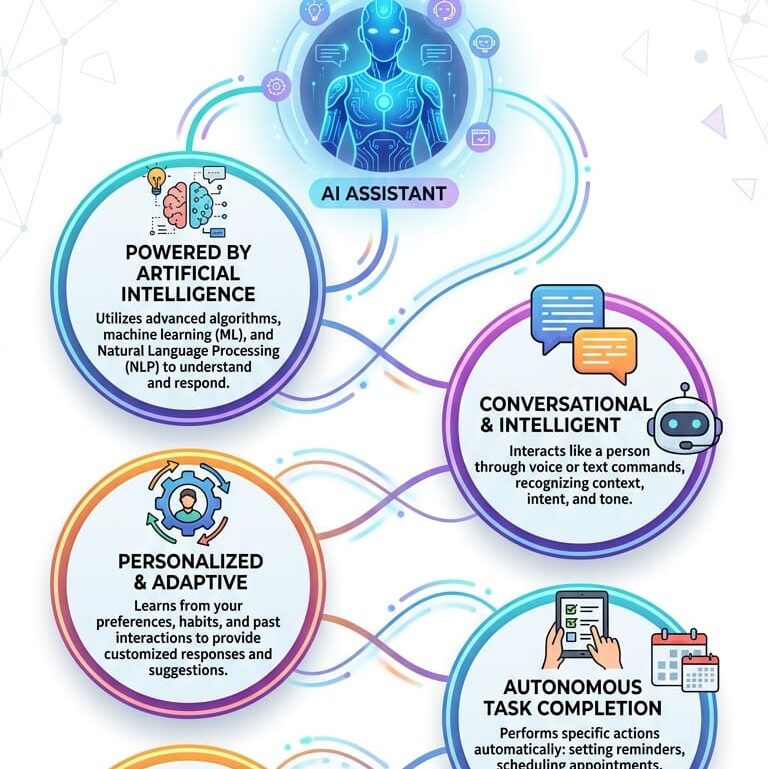
In 2026, AI assistants will be more advanced than ever. They can understand natural language, learn from user preferences, automate repetitive tasks, and even make intelligent recommendations.
Whether you’re using a virtual assistant on your smartphone, an AI-powered chatbot for customer service, or a workplace productivity tool, AI assistants are becoming an essential part of modern life.
This guide explains what AI assistants are, how they work, their benefits, limitations, types, use cases, and what the future holds for this rapidly evolving technology.
What Is an AI Assistant?
An AI assistant is a software application powered by artificial intelligence that can perform tasks, answer questions, and assist users through natural language interactions.
Unlike traditional software that follows fixed instructions, AI assistants can understand context, interpret requests, and provide relevant responses. They use technologies such as:
- Machine Learning (ML)
- Natural Language Processing (NLP)
- Large Language Models (LLMs)
- Speech Recognition
- Predictive Analytics
AI assistants can interact through text, voice, or both. Popular examples include ChatGPT, Google Assistant, Siri, Microsoft Copilot, and Alexa.
Their primary goal is to help users save time, improve productivity, and simplify complex tasks.
How Does an AI Assistant Work?
AI assistants rely on multiple technologies working together.
1. Natural Language Processing (NLP)
NLP enables AI assistants to understand human language.
For example, if a user says:
“Schedule a meeting with my team tomorrow at 10 AM.”
The assistant identifies:
- Action: Schedule
- Event: Meeting
- Participants: Team
- Time: Tomorrow at 10 AM
It then performs the requested task.
2. Machine Learning
Machine learning allows AI assistants to improve over time.
As users interact with the assistant, it learns:
- Communication preferences
- Frequently used commands
- Behavioral patterns
- Personalized recommendations
This makes responses more accurate and useful.
3. Large Language Models
Modern AI assistants are powered by advanced language models trained on massive datasets.
These models can:
- Answer questions
- Summarize information
- Generate content
- Translate languages
- Write code
- Provide recommendations
The more advanced the language model, the more human-like the interaction becomes.
4. Data Integration
Many AI assistants connect with external applications such as:
- Email platforms
- Calendars
- CRM systems
- Project management tools
- Cloud storage
This allows them to perform actions beyond simple conversations.
Types of AI Assistants
AI assistants come in several forms.
1. Personal AI Assistants
Designed for everyday users.
Examples:
- Siri
- Alexa
- Google Assistant
Common tasks include:
- Setting alarms
- Sending messages
- Playing music
- Checking weather
2. Workplace AI Assistants
Built to enhance productivity.
Examples:
- Microsoft Copilot
- ChatGPT
- Notion AI
These tools help with:
- Writing documents
- Creating presentations
- Data analysis
- Meeting summaries
3. Customer Service AI Assistants
Used by businesses to support customers.
Functions include:
- Answering FAQs
- Resolving issues
- Processing orders
- Providing 24/7 support
4. AI Coding Assistants
Created specifically for developers.
Examples include tools that help:
- Generate code
- Detect bugs
- Suggest improvements
- Explain programming concepts
5. AI Sales and Marketing Assistants
These assistants help businesses:
- Generate leads
- Write marketing copy
- Analyze campaigns
- Automate outreach
Key Features of AI Assistants
Modern AI assistants offer a wide range of capabilities.
Natural Conversations
Users can communicate using everyday language.
Example:
Instead of using complex commands, users simply ask:
“What’s on my schedule today?”
Task Automation
AI assistants automate repetitive tasks such as:
- Data entry
- Email responses
- Scheduling
- Report generation
Content Creation
Many AI assistants can generate:
- Articles
- Emails
- Social media posts
- Product descriptions
- Reports
Voice Interaction
Voice-enabled assistants allow hands-free operation.
This is especially useful for:
- Driving
- Smart homes
- Accessibility needs
Personalization
AI assistants learn user preferences and customize responses accordingly.
Examples include:
- Recommended music
- Preferred meeting times
- Frequently used workflows
Benefits of AI Assistants
AI assistants provide numerous advantages.
Increased Productivity
They complete routine tasks quickly, allowing users to focus on high-value work.
Businesses often report significant time savings through AI-powered automation.
Improved Efficiency
Tasks that previously required hours can now be completed in minutes.
Examples include:
- Drafting emails
- Creating reports
- Research assistance
24/7 Availability
Unlike human employees, AI assistants can operate around the clock.
This is particularly valuable for customer support operations.
Cost Reduction
Organizations can reduce operational costs by automating repetitive processes.
This improves scalability without significantly increasing expenses.
Better Decision-Making
AI assistants can analyze large datasets and provide actionable insights.
This helps leaders make informed decisions faster.
Common Use Cases of AI Assistants
AI assistants are used across many industries.
Education
Students use AI assistants for:
- Research
- Note-taking
- Exam preparation
- Learning support
Teachers use them to create lesson plans and educational content.
Healthcare
Healthcare professionals use AI assistants for:
- Documentation
- Appointment scheduling
- Patient communication
- Medical research assistance
Business Operations
Companies use AI assistants to:
- Automate workflows
- Manage projects
- Analyze data
- Improve collaboration
Marketing
Marketing teams rely on AI assistants for:
- Content creation
- Keyword research
- Audience analysis
- Campaign optimization
Customer Support
Businesses deploy AI assistants to:
- Answer common questions
- Route customer inquiries
- Provide instant responses
AI Assistants vs Traditional Virtual Assistants
Many people confuse AI assistants with traditional virtual assistants.
| Feature | AI Assistant | Human Virtual Assistant |
| Availability | 24/7 | Limited Hours |
| Cost | Lower | Higher |
| Scalability | High | Limited |
| Creativity | Moderate | High |
| Emotional Understanding | Limited | Strong |
| Speed | Instant | Variable |
The best approach often combines both AI and human support.
Challenges and Limitations of AI Assistants
Despite their advantages, AI assistants have limitations.
- Accuracy Issues
- AI-generated responses can occasionally contain incorrect information.
- Users should verify critical facts.
- Privacy Concerns
- AI assistants often process large amounts of user data.
- Organizations must implement strong privacy protections.
- Lack of Human Judgment
- AI lacks human intuition and emotional intelligence.
- Complex decisions often require human oversight.
- Dependence on Data Quality
- Poor data can lead to poor outcomes.
- AI performance depends heavily on training data quality.
Security Risks
Businesses must secure AI systems against:
- Data breaches
- Unauthorized access
- Cyber threats
AI Assistants in Business
Businesses are increasingly adopting AI assistants.
Common applications include:
Human Resources
- Resume screening
- Employee onboarding
- Training support
Finance
- Expense tracking
- Financial reporting
- Forecasting
Operations
- Workflow automation
- Process optimization
- Resource management
Sales
- Lead qualification
- Customer engagement
- Sales forecasting
Organizations that effectively implement AI assistants often gain a competitive advantage.
The Future of AI Assistants
The future of AI assistants looks incredibly promising.
Several trends are shaping the next generation of AI.
More Human-Like Conversations
Future assistants will better understand emotions, tone, and context.
Interactions will become increasingly natural.
Multimodal Capabilities
AI assistants will process:
- Text
- Voice
- Images
- Video
- Documents
simultaneously.
Autonomous AI Agents
Advanced assistants will not only answer questions but also independently complete tasks.
Examples include:
- Booking travel
- Managing projects
- Handling customer requests
with minimal human involvement.
Better Personalization
Future AI systems will provide highly customized experiences based on individual preferences and behavior.
Industry-Specific Assistants
Specialized AI assistants will emerge for sectors such as:
- Healthcare
- Legal services
- Finance
- Engineering
- Education
These assistants will offer expert-level support within their domains.
How to Choose the Right AI Assistant
When selecting an AI assistant, consider:
Purpose
Identify your primary use case:
- Writing
- Productivity
- Customer service
- Coding
- Research
Features
Look for capabilities such as:
- Voice support
- Automation
- Integrations
- Content generation
Security
Ensure the platform offers:
- Data encryption
- Compliance standards
- Privacy controls
Ease of Use
A good AI assistant should have an intuitive interface and minimal learning curve.
Pricing
Compare plans based on:
- Features
- Usage limits
- Team requirements
Best Practices for Using AI Assistants
To maximize results:
- Write clear prompts.
- Verify important information.
- Use AI as a productivity tool, not a replacement for critical thinking.
- Protect sensitive data.
- Combine AI output with human expertise.
- Continuously evaluate performance.
- Train teams on responsible AI usage.
Frequently Asked Questions (FAQs)
1. What is an AI assistant?
An AI assistant is software that uses artificial intelligence to perform tasks, answer questions, automate workflows, and assist users through natural language interactions.
2. How do AI assistants work?
They use technologies such as natural language processing, machine learning, and large language models to understand and respond to user requests.
3. Are AI assistants the same as chatbots?
No. Chatbots are usually designed for specific conversations, while AI assistants can perform a broader range of tasks and integrate with multiple applications.
4. What are examples of AI assistants?
Examples include ChatGPT, Google Assistant, Siri, Alexa, and Microsoft Copilot.
5. Can AI assistants improve productivity?
Yes. They automate repetitive tasks, generate content, organize information, and help users complete work more efficiently.
6. Are AI assistants safe to use?
Generally yes, but users should choose reputable platforms and avoid sharing highly sensitive information unnecessarily.
7. Can AI assistants replace human workers?
AI assistants can automate certain tasks but are more likely to augment human work rather than fully replace most jobs.
8. What industries use AI assistants?
Industries including healthcare, education, finance, marketing, customer service, and software development use AI assistants extensively.
9. Do AI assistants learn from users?
Many AI assistants can adapt to user preferences and improve personalization over time.
10. What is the future of AI assistants?
Future AI assistants will be more intelligent, autonomous, multimodal, and capable of handling complex tasks with minimal human intervention.
Conclusion
AI assistants have evolved from simple digital helpers into powerful productivity tools capable of transforming how people work and live. They can automate tasks, generate content, analyze information, and provide intelligent support across countless industries.
As artificial intelligence continues to advance, AI assistants will become more capable, personalized, and autonomous. Businesses can improve efficiency and reduce costs, while individuals can save time and enhance productivity.
Although challenges such as privacy, accuracy, and security remain important considerations, the benefits of AI assistants are substantial. Understanding how these tools work and how to use them effectively is essential for anyone looking to thrive in the AI-powered future.