Artificial intelligence is transforming software development faster than ever before. In 2026, building an application no longer requires years of coding experience or a large development team.
AI app builders can generate interfaces, write code, create databases, automate workflows, and even deploy applications with simple natural language prompts.
Whether you’re an entrepreneur launching a startup, a freelancer building client projects, or a business owner creating internal tools, AI-powered app builders can dramatically reduce development time and costs.
In this guide, we’ll explore the 9 best AI app builders for 2026, their key features, pros and cons, pricing considerations, and who they are best suited for.
What Are AI App Builders?
AI app builders are software platforms that use artificial intelligence to help users create web apps, mobile apps, and business applications with minimal coding.
Instead of manually writing thousands of lines of code, users can simply describe what they want, such as:
“Create a task management app with user login, project tracking, and team collaboration.”
The AI then generates the necessary:
- User interface (UI)
- Backend logic
- Database structure
- API connections
- Authentication systems
- Workflows and automations
These platforms are making software development accessible to non-technical users while also helping professional developers work faster.
Why AI App Builders Are Growing in 2026
Several factors are driving the popularity of AI app builders:
- Faster Development
- Apps that previously took months can now be created in days or even hours.
- Lower Costs
- Businesses can reduce reliance on large development teams.
- No-Code Accessibility
- Non-programmers can build sophisticated applications.
- AI-Powered Automation
- Many platforms automatically generate workflows and business logic.
- Rapid Prototyping
- Startups can validate ideas before investing heavily in development.
1. Bubble AI
Overview
Bubble has long been one of the leading no-code platforms, and its AI capabilities have made it even more powerful in 2026.
Users can describe an application in natural language, and Bubble AI creates layouts, workflows, and databases automatically.
Key Features
- AI-generated applications
- Visual drag-and-drop editor
- Database management
- Workflow automation
- API integrations
- Mobile-responsive design
Pros
- Beginner-friendly
- Strong community support
- Flexible customization
- Excellent for startups
Cons
- Learning curve for advanced features
- Performance may vary for very large apps
Best For
Entrepreneurs and startup founders.
2. Glide
Overview
Glide transforms spreadsheets into powerful applications using AI-assisted development.
It is especially useful for businesses creating internal tools, CRMs, inventory systems, and customer portals.
Key Features
- Spreadsheet-based app creation
- AI-generated interfaces
- Workflow automation
- Real-time collaboration
- Mobile optimization
Pros
- Extremely easy to use
- Fast deployment
- Great for business operations
Cons
- Less flexible for complex apps
- Limited advanced customization
Best For
Small businesses and internal business tools.
3. Softr
Overview
Softr combines no-code development with AI-powered app generation, making it simple to create customer portals, marketplaces, directories, and SaaS products.
Key Features
- AI app generation
- Airtable integration
- Membership portals
- Custom workflows
- Responsive design
Pros
- User-friendly interface
- Fast setup
- Strong database integrations
Cons
- Advanced features may require higher-tier plans
Best For
Freelancers and small businesses.
4. Builder.ai
Overview
Builder.ai uses AI to simplify custom software development through guided app creation.
Its AI assistant helps users design, build, and launch applications without traditional coding expertise.
Key Features
- AI-driven app creation
- Mobile and web app support
- Project planning assistance
- Automated development workflows
- Cloud deployment
Pros
- Enterprise-friendly
- Strong project management tools
- Professional-grade applications
Cons
- Can be more expensive than no-code alternatives
Best For
Businesses require custom software solutions.
5. Replit Agent
Overview
Replit Agent is changing how developers build applications by allowing users to describe projects in plain English.
The AI writes code, fixes bugs, creates databases, and deploys applications directly within the platform.
Key Features
- AI coding assistant
- Full-stack development
- Instant deployment
- Database integration
- Real-time collaboration
Pros
- Excellent for developers
- Supports custom coding
- Rapid prototyping
Cons
- Some coding knowledge is helpful
Best For
Developers and technical founders.
6. Lovable
Overview
Lovable has become one of the fastest-growing AI app builders in 2026.
Users can describe an application idea, and the platform generates production-ready applications with modern UI designs.
Key Features
- Prompt-to-app generation
- AI UI design
- Database integration
- Authentication systems
- API support
Pros
- Beautiful interfaces
- Quick app generation
- Modern development workflow
Cons
- Newer platform compared to competitors
Best For
Startups launching MVPs quickly.
7. Bolt.new
Overview
Bolt.new enables users to create full-stack web applications directly from prompts.
Its AI can generate frontend and backend code, configure environments, and help deploy projects.
Key Features
- Prompt-based development
- Full-stack support
- Instant coding environment
- AI debugging
- Fast prototyping
Pros
- Extremely fast
- Developer-friendly
- Strong AI assistance
Cons
- Best suited for web apps
Best For
Web developers and startups.
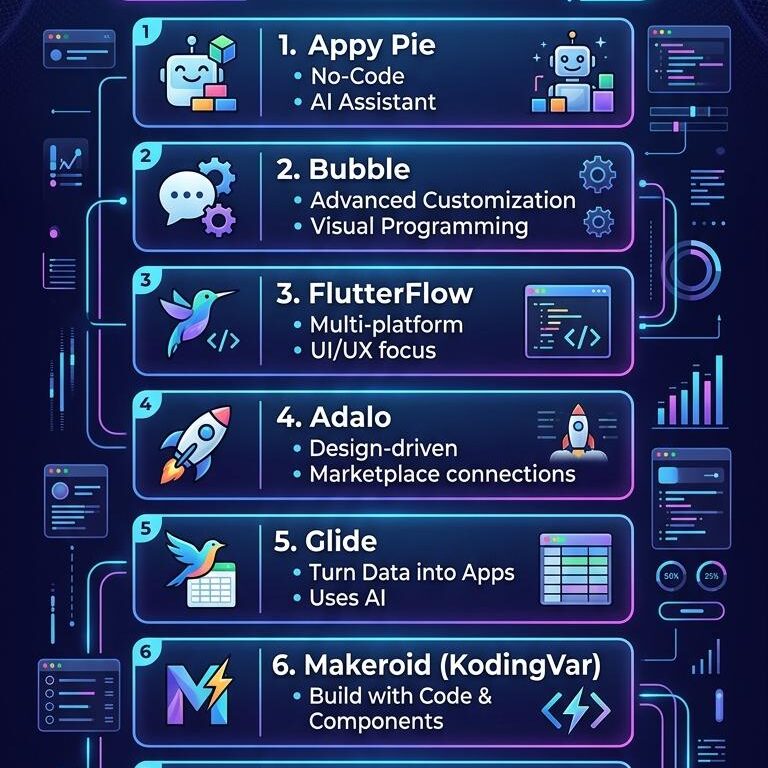
8. Appy Pie AI App Builder
Overview
Appy Pie remains one of the most accessible no-code platforms for small businesses.
Its AI-powered tools allow users to build mobile applications without technical expertise.
Key Features
- Drag-and-drop editor
- AI app generation
- Mobile app publishing
- Push notifications
- Business automation
Pros
- Beginner-friendly
- Affordable
- Easy publishing process
Cons
- Limited advanced customization
Best For
Small businesses and first-time app creators.
9. Microsoft Power Apps with Copilot
Overview
Microsoft has integrated powerful AI capabilities through Copilot into Power Apps.
Users can create enterprise applications simply by describing their requirements.
Key Features
- Natural language app creation
- Deep Microsoft ecosystem integration
- Enterprise security
- Workflow automation
- AI Copilot assistance
Pros
- Excellent enterprise support
- Strong security features
- Seamless Microsoft integration
Cons
- Best utilized within Microsoft environments
Best For
Large organizations and enterprise teams.
Comparison Table
| Platform | Best For | Coding Required | AI Features |
| Bubble AI | Startups | No | High |
| Glide | Internal Tools | No | Medium |
| Softr | Business Apps | No | High |
| Builder.ai | Custom Software | Low | High |
| Replit Agent | Developers | Some | Very High |
| Lovable | MVP Development | Low | Very High |
| Bolt.new | Web Apps | Some | Very High |
| Appy Pie | Beginners | No | Medium |
| Power Apps | Enterprises | Low | High |
How to Choose the Right AI App Builder
Before selecting a platform, consider the following:
Your Technical Skills
Beginners should consider:
- Glide
- Softr
- Appy Pie
Developers may prefer:
- Replit Agent
- Bolt.new
- Lovable
Budget
Some platforms offer affordable entry plans, while enterprise solutions can be significantly more expensive.
Type of Application
Choose based on whether you’re building:
- Mobile apps
- Web applications
- Internal business tools
- SaaS platforms
- Enterprise software
Scalability
Ensure the platform can support future growth and increasing user demands.
Future of AI App Development
The future of app development is increasingly AI-driven. Experts expect future platforms to provide:
- Fully autonomous app generation
- Automated testing
- AI-generated marketing assets
- Intelligent user experience optimization
- Self-healing applications
- Voice-based development workflows
By 2026 and beyond, AI app builders will continue reducing barriers to software creation, allowing more people than ever to turn ideas into functional applications.
FAQs
1. What is an AI app builder?
An AI app builder is a platform that uses artificial intelligence to help users create applications through prompts, automation, and visual development tools.
2. Can I build an app without coding?
Yes. Most AI app builders allow users to create apps without writing code.
3. Which AI app builder is best for beginners?
Glide and Appy Pie are among the easiest platforms for beginners.
4. Are AI-generated apps production-ready?
Many modern platforms can generate production-ready applications, though testing and customization are still recommended.
5. Can AI app builders create mobile apps?
Yes. Many platforms support both Android and iOS app development.
6. Which platform is best for startups?
Bubble AI, Lovable, and Builder.ai are popular choices for startups.
7. Are AI app builders expensive?
Pricing varies widely. Some offer free plans, while enterprise solutions can cost hundreds or thousands of dollars per month.
8. Can developers benefit from AI app builders?
Absolutely. Developers use AI builders to speed up coding, debugging, and deployment.
9. Do AI app builders support integrations?
Most platforms support APIs, databases, payment systems, and third-party integrations.
10. What is the future of AI app builders?
Future platforms will likely offer fully autonomous development, advanced automation, and intelligent application optimization with minimal human intervention.
Conclusion
AI app builders have evolved from simple no-code tools into sophisticated platforms capable of generating complete applications with minimal effort. Whether you’re launching a startup, building internal business software, or creating a mobile app, today’s AI-powered builders can significantly accelerate development.
For beginners, Glide and Appy Pie offer simple experiences. For startups, Bubble AI, Lovable, and Builder.ai are strong choices. Developers may prefer Replit Agent and Bolt.new, while enterprises can benefit from Microsoft Power Apps with Copilot.
The right platform ultimately depends on your goals, budget, and technical expertise, but one thing is certain: AI is reshaping how software gets built.